When a couple is struggling with sexual intimacy, the instinctual advice they often receive is to "try harder"—schedule bedroom dates, force spontaneous encounters, buy new lingerie, or push through awkward feelings. Yet for many partners, this well-meaning advice backfires completely. Instead of rekindling desire, pushing through discomfort turns physical closeness into a high-stakes test, breeding performance anxiety, emotional withdrawal, and deep resentment.
In clinical sex therapy, when bedroom tension becomes chronic, experienced therapists rarely advise couples to dive straight into intercourse. Instead, they recommend something counterintuitive and profoundly liberating: taking an intentional sex break.
A sex break—often structured around clinical techniques like Sensate Focus developed by renowned researchers Dr. William Masters and Virginia Johnson—is not an admission of defeat or a step toward separation. Rather, it is a deliberate, agreed-upon pause on climax-oriented performance that removes fear, resets your nervous system, and clears the slate so that genuine pleasure, emotional safety, and spontaneous affection can return.

The Psychology of Bedroom Pressure: Why "Trying Harder" Fails
To understand why hitting pause works, it is essential to explore how performance pressure sabotages human desire. Intimacy is fundamentally governed by the autonomic nervous system. Arousal requires the parasympathetic nervous system ("rest, digest, and connect") to be fully engaged. When anxiety, obligation, or fear of failure enters the bedroom, the sympathetic nervous system ("fight, flight, or freeze") takes over, flooding the bloodstream with adrenaline and cortisol.
- The Curse of "Spectatoring": Masters and Johnson coined the term "spectatoring" to describe the habit of mentally stepping outside your own body during intimacy to critically evaluate your performance, physical appearance, or responsiveness. Spectatoring kills sensory pleasure instantly.
- Goal-Oriented vs. Pleasure-Oriented Intimacy: Modern culture often defines successful intimacy solely by an end goal—orgasm. When intimacy is treated as a task with a pass/fail metric, any difficulty reaching that goal feels like personal rejection or inadequacy.
- The Pursuer-Distancer Dynamic: When desire levels fluctuate, one partner often becomes the "pursuer" (seeking validation and closeness through physical touch) while the other becomes the "distancer" (feeling overwhelmed by unspoken expectations). The more the pursuer pushes, the more the distancer pulls away.
- The "Loss of Innocent Touch": When intimacy becomes strained, casual physical affection disappears. A back massage, an innocent snuggle on the couch, or a gentle kiss on the neck begins to feel like a veiled sexual advance, causing the hesitant partner to stiffen up or avoid physical contact entirely.
💡 Clinical Insight: The Masters & Johnson Sensate Focus Protocol
Introduced in the 1970s and still widely used in modern sex therapy, Sensate Focus explicitly forbids intercourse during initial treatment stages. By legally "banning" sexual performance, couples are freed to rediscover sensory touch without the paralyzing fear of "where this has to lead."
6 Telltale Signs Your Relationship Needs a Sex Break
How do you know whether you simply need a fun weekend away or if your partnership would truly benefit from an intentional, structured sex break? Look for these six clinical indicators:
If heading to bed at night fills you or your partner with a knot in your stomach—wondering whether an advance will be made, how you will decline it, or whether you will be able to perform—your bedroom has become associated with stress rather than sanctuary.
You no longer hold hands while watching a movie, cuddle in the morning, or hug each other for longer than two seconds because both of you fear that non-sexual affection will be misinterpreted as an invitation for intercourse.
One partner engages in "duty sex" solely to avoid conflict, soothe guilt, or keep the peace. Engaging in intimacy without genuine internal arousal teaches the body to associate physical closeness with emotional violation.
Whether dealing with erectile difficulties, rapid climax, pain during intercourse, postpartum recovery, or hormonal transitions, continuing to push through physical resistance reinforces negative subconscious pathways.
Any mention of intimacy immediately derails into defensiveness, tears, accusations of "you don't love me anymore," or icy stonewalling. When emotional safety is shattered, communication must be repaired before bedroom play can resume.
You coordinate schedules, manage finances, and care for children like an efficient executive team, but the romantic, flirtatious, and curious spark between you has gone completely dormant.
Download Our Games for Couples Connection
Struggling to find words or take the pressure off your relationship? Download Love Secret free on the App Store for 1,000+ zero-pressure conversation cards, gentle quizzes, and fun connection challenges designed to bring partners closer.
What an Intentional Sex Break Is (and What It Isn't)
The phrase "sex break" can initially sound terrifying. Partners often fear it signals the beginning of an open marriage, celibate estrangement, or divorce. It is vital to clarify what a therapeutic sex break truly entails:
- What It Is NOT: It is NOT emotional withholding, a punishment for past behavior, a unilateral declaration ("I'm never touching you again"), or an indefinite freeze on romantic life.
- What It IS: It is a mutually agreed-upon, time-limited container (typically 2 to 4 weeks) where sexual performance and genital touch are temporarily taken off the table. Its sole purpose is to rebuild trust, relax the nervous system, and allow affection to thrive without fear.
When both partners understand that the break is an investment in their long-term intimacy, a profound sense of relief sweeps through the relationship. The distancer no longer has to put up defensive walls, and the pursuer no longer has to wonder whether every interaction will lead to rejection.
The 7-Step Roadmap: How to Take a Healthy, Reconnecting Sex Break
A successful sex break requires structure, clear boundaries, and proactive nurturing of non-sexual intimacy. Follow this proven 7-step guide to make your pause restorative and deeply romantic:
Action: Choose a relaxed moment on a weekend afternoon—never right before bed or during an argument. Frame the idea collaboratively: "I love you and want our intimacy to feel joyful for both of us. Right now, I sense we are both feeling stressed and pressured. What if we take all sexual pressure off the table for the next three weeks so we can just focus on laughing, cuddling, and connecting again?"
Key Rule: Ensure both partners agree voluntarily; mutual consent creates emotional safety.
Action: Agree on a designated timeline, such as 21 or 30 days. Mark a date on the calendar for a relationship check-in.
Why It Works: An open-ended pause creates anxiety ("Is this forever?"), whereas a defined window allows both partners to relax knowing there is a clear roadmap.
Action: Bring back non-demand physical affection. Practice the 6-second kiss (proven by Dr. John Gottman to release oxytocin), lingering morning hugs, holding hands in the car, and spooning on the couch without any expectation of escalation.
Why It Works: Teaches your subconscious mind that touch is safe, comforting, and nurturing—not a contract for physical escalation.
Action: Dedicate 20 minutes once or twice a week to non-genital sensory massage. One partner lies down comfortably while the other gently caresses their back, shoulders, arms, or feet with varying pressures, textures, or warm lotion. Switch roles halfway through.
Mindset: The goal is not to arouse, but simply to tune in to pleasant sensory sensations and breathe together.

Action: When physical pressure is removed, emotional conversations need to fill the space. Use conversation card apps like Love Secret to ask open-ended questions about early memories, secret bucket lists, hilarious hypothetical scenarios, and deep relationship values.
Why It Works: Gamification dissolves social stiffness, sparks laughter, and reminds you why you fell in love with each other's minds.
Action: Plan fun date nights where you go out for ice cream, explore a new hiking trail, visit an arcade, or take a cooking class together. Since sex is officially off the table at the end of the night, you can flirt, dress up, and hold hands with total lighthearted freedom.
Action: When your designated timeframe ends, sit down and evaluate. How did it feel? Do you feel closer? If you both feel genuine mutual longing and desire, do not jump straight to full intercourse. Start with passionate kissing, mutual exploration, and laughter. If either partner feels hesitation, extend the pause for another week without guilt.

Rediscover Playful Connection with Love Secret
Break the ice and make date night fun again. Download Love Secret free on the App Store to unlock hundreds of pressure-free couples questions, romantic dice, and intimacy-building games.
How the Love Secret App Supports Couples During an Intimacy Reset
Navigating an intimacy reset can feel awkward if you don't know where to start. Love Secret is specifically crafted to bridge the gap between emotional distance and joyful romantic reconnection:
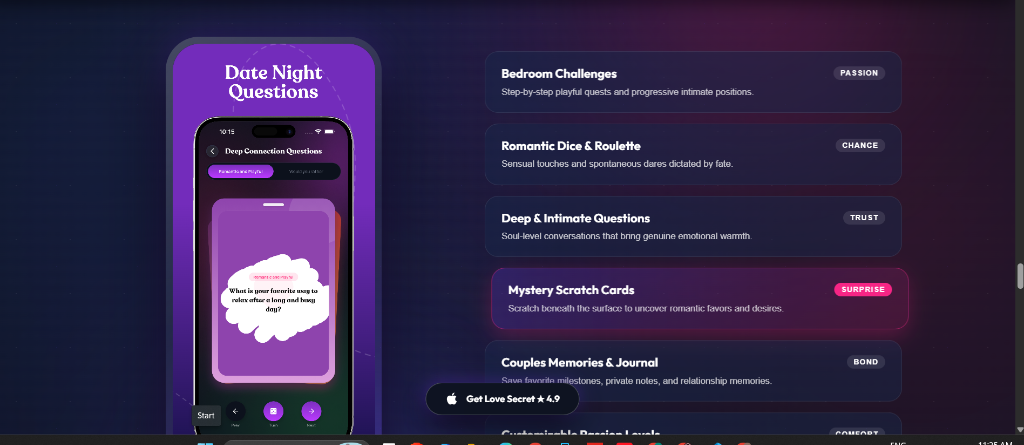
- 1,000+ Pressure-Free Conversation Prompts: Gentle decks covering relationship appreciation, sweet nostalgia, playful hypotheticals, and future dreams that foster deep emotional resonance.
- Romantic Dice & Touch Prompts: Gentle, gamified suggestions—like a 30-second back rub, holding hands while taking three deep breaths, or giving three sincere compliments—that make physical affection low-pressure and spontaneous.
- Mystery Scratch Cards: Fun, randomized date-night activities hidden behind digital scratch layers to bring back childlike curiosity and surprise.
- Completely Safe & Consensual: Every prompt includes an effortless skip button, guaranteeing that both partners remain entirely within their comfort zone.
Frequently Asked Questions (FAQ)
Won't taking a sex break make us grow further apart?
Only if you disengage emotionally. When a sex break is done properly, it replaces high-stakes bedroom pressure with non-demand cuddles, deep conversations, romantic dates, and active play, which actually draws couples much closer together.
How long should an intentional sex break last?
Most relationship therapists recommend 2 to 4 weeks (14 to 30 days). This duration is long enough to dissolve subconscious anxiety and reset dopamine pathways, while short enough to maintain intentional momentum.
How do I propose a sex break to my partner without hurting their feelings?
Focus on closeness and mutual relief rather than inadequacy. Say: "I love you and want our intimacy to feel effortless and joyful. Right now, I sense we are both feeling some pressure. Let's take sex off the table for three weeks so we can just focus on cuddling, laughing, and dating each other again."
What is Sensate Focus, and can couples practice it without a therapist?
Sensate Focus is a behavioral exercise where partners take turns exploring non-genital sensory touch (massages, light caresses) with no expectation of climax or escalation. Couples can easily practice it at home in 15-20 minute sessions with warm lotion, dim lighting, and soft music.
How does the Love Secret app help when intimacy feels strained?
Love Secret removes awkwardness by providing neutral, gamified prompts. Instead of struggling to find what to talk about or feeling pressured for physical intimacy, the app offers structured questions, romantic dice, and gentle connection games that spark laughter and warmth.
Download Our Games for Couples Connection
Ready to replace relationship stress with genuine romantic spark? Download Love Secret free on the App Store today to enjoy hundreds of questions, romantic dice, and connection games tailored for couples.
Want to Play These Questions Tonight?
Love Secret features hundreds of deep conversation cards, randomized dice, and scratch-off challenges designed for every couple.